

2025 Sees Accelerated Domestic Substitution in High-End Medical Devices: Key Sectors to Watch
Click:
Time:2024-04-22 12:16:00
As an important tool of modern medical care, high-end medical devices play an extremely important role in the prevention, diagnosis and treatment of diseases, and their strategic position is highly valued by countries around the world. In the context of the deep restructuring of the global supply chain, our country's high-end medical device field is accelerating to achieve technological breakthrough and industrial upgrading.
01 Strategic layout
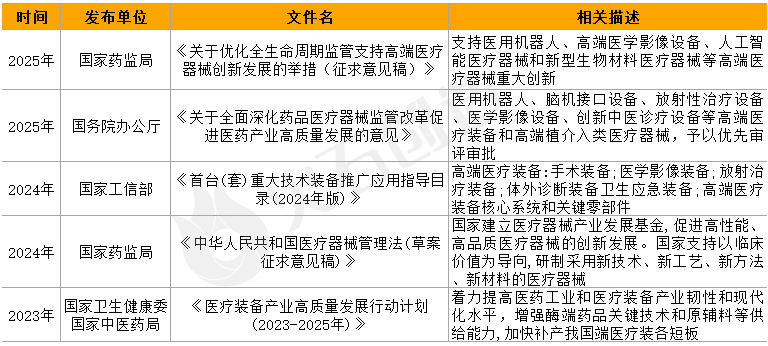
In recent years, the state has vigorously supported the accelerated adjustment of the high-end device industry structure and introduced a series of policies aimed at promoting the high-quality development of the industry through technological innovation, regulatory optimization, industrial chain upgrading and other dimensions.
Table: Policies to support the development of high-end medical devices at the national level in the past three years
Source: Flint Creation Industrial Data Center
Locally, since the beginning of this year, Beijing, Henan, Shenzhen and other provinces and cities have introduced corresponding policies to fully support the development of high-end medical devices.
Beijing issued the 'Several Measures to Support the High-quality Development of Innovative Medicine in Beijing (2025)', proposing to establish a green channel for innovative drugs and devices that are urgently needed in clinical practice or have significantly improved efficacy, and give priority support and guarantee;
Henan issued the 'Notice on Printing and Distributing the Layout and Construction Plan of Medical Instrument and Equipment Industrial Park in Henan Province', aiming at high-end medical equipment, high-value medical consumables, high-efficiency diagnostic products and other medical instrument and equipment segments, building a number of specialized, high-end and high-quality industrial parks, and creating a high-quality development and growth pole of the medical instrument and equipment industry in Henan Province;
Shenzhen issued the 'Several Measures to Support the Development of Medicine and Medical Devices in the Whole Chain of Shenzhen', proposing to focus on high-end medical imaging, medical robots, high-performance implant interventional devices, in vitro diagnosis, life monitoring and support, artificial intelligence-assisted diagnostic systems and other directions to support the development of high-end medical device products......
02 Key track
In 2025 our country, due to geopolitical conflicts and tariff frictions, innovation breakthroughs and domestic substitution will be further accelerated in high-end markets and high-tech segments. The following areas are worth paying attention to:
1. Brain-computer interface
Brain-computer interface has become a key strategic direction for our country to break through the technological blockade, and it is also a future industry that the country focuses on developing. At present, our country's brain-computer interface industry has begun to take shape. In 2024, our country's brain-computer interface market size will be 3.2 billion yuan, a year-on-year increase of 18.8%, and it is expected to reach 5.58 billion yuan by 2027, with a growth rate of 20%. However, it is still facing multiple challenges such as technical bottlenecks, talent gaps, and ethical disputes, and it is urgent to focus on targeted technology research, integration of industry and education to cultivate talents, capital empowerment and efficiency, and standard system construction.
Table: Some enterprises with brain-computer interfaces

Source: Flint Creation Industrial Data Center
Brain Technology
The first unicorn company in the field of brain-computer interface in China, focusing on the research and development and application of non-invasive brain-computer interface technology, has developed a dry electrode sensor without conductive paste, which greatly improves the convenience and accuracy of EEG signal collection. In 2025, its high-precision brain-computer interface products will achieve mass production of 100,000 units.
Hanwei Technology
The new brain-computer interface micro-nano sensor developed by Suzhou Nengstar, a leading sensor company, integrates skin-like flexible sensing technology and nanomaterial technology, which is at the forefront of China and provides the possibility of non-invasive brain-like interaction.
2. High-end medical imaging equipment
In recent years, our country's medical imaging equipment industry has developed rapidly, the supply chain has been gradually improved, and it has large-scale R&D and production capacity of medical magnetic resonance, CT, ultrasound and other medical imaging equipment, and the localization rate of medical imaging equipment has also been continuously improved, especially in the field of low-end products.
Technical barriers and insufficient localization of core components are the main obstacles. Multinational giants have long mastered the original data interface and technical standards of imaging equipment, forming a moat of data ecology, which makes domestic equipment at a disadvantage in terms of core data. At the level of key components, the localization rate of core components such as CT tubes and superconducting magnets is less than 30%, making domestic equipment face uncertainty in production and maintenance.
Table: Some high-end medical imaging equipment enterprises

Source: Flint Creation Root Industrial Data Center
United Imaging Medical
A leading enterprise in medical imaging equipment. It took 13 years to establish an independent manufacturing system for high-field magnetic resonance complete machines, developed our country's first 3T human magnetic resonance imaging equipment, innovated rapid imaging sequences such as heart and brain and quantitative diagnosis technology for major diseases, obtained the first domestic 3T human medical magnetic resonance imaging system registration certificate, and successfully developed the world's first 5T whole body magnetic resonance imaging system, which is sold to Europe, the United States and other countries and regions.
Mindray Medical
Mindray Medical has successfully developed the industry's first photoacoustic imaging system that can be used in human clinical practice in ultrasound diagnosis, achieving a breakthrough in ultrasound from anatomical imaging to functional imaging. At the same time, the ultrasound super-resolution imaging and other functions developed by Mindray Medical have improved the resolution of hemodynamics from millimeters to micrometers, and have reached a leading level in terms of penetration and micro-blood flow perfusion resolution.
3. Surgical robot
Surgical robots are comprehensive medical devices that integrate a number of modern high-tech means and can be used for surgical image guidance and minimally invasive surgery. From the perspective of clinical medical applications, surgical robots can be divided into laparoscopic surgical robots, orthopedic surgical robots, panvascular surgical robots, translucentesis surgical robots, percutaneous puncture surgical robots and other surgical robots (such as neurosurgical robots).
Among them, laparoscopic surgical robots occupy the largest market for surgical robots. At present, Da Vinci occupies the main market position of laparoscopic surgical robots, but as a number of domestic products enter the clinical and marketing period, this pattern will be broken and the import localization of laparoscopic surgical robots will be realized.
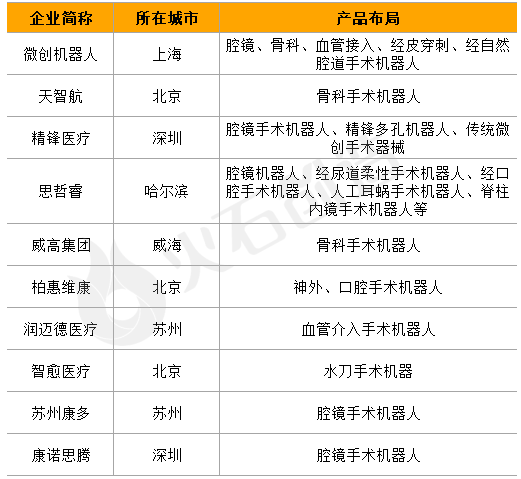
Table: Some surgical robot companies
Source: Flint Creation Root Industrial Data Center
Minimally invasive robot
Minimally invasive robots are backed by minimally invasive medical groups, and their products cover five major specialties: laparoscopic, orthopedics, panvascular, transnatural cavity and percutaneous puncture surgery. It has 3 flagship products: Dragonfly Eye 3D electronic laparoscope, Tumai laparoscopic surgical robot, and Honghu joint replacement surgical robot. Among them, the Tumai laparoscopic surgical robot is the first domestic four-arm surgical robot to break the monopoly of da Vinci.
Jingfeng Medical
Jingfeng Medical is committed to designing, developing and manufacturing surgical robots, providing innovative solutions for minimally invasive surgery, and is the first company in China and the second in the world to master both single-port and multi-port surgical robot technology. Products include multi-hole laparoscopic surgical robots, single-port laparoscopic surgical robots, trans-natural orifice surgical robots and traditional minimally invasive surgical instruments. The multi-hole laparoscopic robot has obtained CE certification, accounting for 15% of overseas orders in 2024, mainly in secondary hospitals in Europe and the United States.
4. High-value consumables
High-value consumables account for about 20% of the market size of medical devices, and have high value and technical content, which is an important part of medical devices. At present, the domestic share of high-value medical consumables in different segments varies greatly. Most of the other products are still mainly imported products, especially in the fields of pacemakers, neurointerventional consumables, dental implants and other fields.
Table: High-value consumables enterprises in the department

Source: Flint Creation Root Industrial Data Center
Minimally invasive medical care
A multinational high-end medical device company, its products have entered more than 20,000 hospitals in more than 100 countries around the world. The business covers 12 fields such as cardiovascular intervention, neuroregulation, and medical robots. The proportion of overseas revenue jumped from 15% to 28% within three years, and the CE/FDA certification was accelerated, forming a differentiated competitive advantage in emerging markets such as Southeast Asia. It holds more than 6,000 global patents (including 1,500 PCTs), and its self-developed bioabsorbable heart stent 'Fire Ibis' will be approved by the State Food and Drug Administration in 2024.
Weigao Group
The leading enterprise of disposable medical consumables in China covers eight product lines: clinical care, trauma management, blood management, drug packaging, medical testing, anesthesia and surgery, orthopedic consumables, and interventional consumables. Indwelling needles, flushing syringes, etc. have filled the domestic technical gap, and many products such as pre-filled syringes and orthopedic implant materials have broken foreign monopolies.
5. In vitro diagnostics
Immunodiagnosis, biochemical diagnosis, POCT and molecular diagnosis are the main subdivisions of IVD. our country's IVD industry has achieved most of the localization in the low-end technology field, such as enzyme-linked immunology technology and clinical biochemical diagnosis technology, while in the mid-to-high-end technology field, such as chemiluminescence detection and POCT, it is still occupied by foreign brands.
For example, in the field of chemiluminescence in vitro diagnostic segments, equipment barriers are high, resulting in most of China's chemiluminescence market being occupied by imported products, and the Big Four of 'Luo Ya Besi' account for more than 70% of the domestic chemiluminescence market share, and there is a broad space for domestic substitution. The industry calls Shenzhen's Mindray Medical, New Industry, Yahuilong, Zhengzhou's Antu Biotech and Chengdu's Mike Biotech as the 'Luminous Five Tigers'.
Table: Some in vitro diagnostic enterprises

Source: Flint Creation Root Industrial Data Center
New industry
It is the first company in China to have a patent for 'immunomagnetic microspheres' and use it as a key separation material for chemiluminescence systems, the first company in China to have a patent for 'artificially synthesized small molecule organic compounds - ABEI' and use it to replace traditional enzymes as luminescence markers, and it is also the first company in China to apply the above patented technology and obtain a domestic registration certificate and realize mass production of fully automatic direct chemiluminescence immunoassay instruments and supporting reagents.
Antu Bio
The first in vitro diagnostic manufacturer in China to be listed on the main board of Shanghai. With a rich product line, it can provide comprehensive clinical immunoassay, biochemical testing and microbial testing solutions, covering many directions in the fields of immunoassay, biochemical testing and microbial testing, and is one of the most comprehensive testing projects in China.
—END—

Copyright © 2025 Worldcross Industries Co., Ltd.All Rights Reserved.

 Contact 1
 Contact 2
 Contact 4